Children &Climate &COVID-19 &Diagnosis &Mosquitoes &Resistance Bill Brieger | 31 Aug 2020
Malaria News Today 2020-08-31
From time-to-time we will feature a collection of news and abstracts available “today.” Here are five stories available on 31st August 2020.
Med-tech on a leash: The many diseases that can be detected by dogs
Malaria, a parasitic disease, which is transmitted to humans by Anopheles mosquitoes, can also be detected by our canine friends. In 2019, English researchers presented the results of a study conducted in The Gambia, which involved training dogs with socks that had been worn by children infected with malaria, who otherwise had no symptoms.
The experiment proved to be so successful that researchers are now planning on using this method to test for asymptomatic cases of the disease….
New Malaria Transmission Patterns Emerge In Africa.
An international study reveals how future climate change could affect malaria transmission in Africa over the next century. Malaria is a climate sensitive disease; it thrives where it is warm and wet enough to provide surface water suitable for breeding by the mosquitoes that transmit it. For more than two decades now, scientists have suggested that climate change may alter the distribution and length of transmission seasons due to new patterns of temperature and rainfall. The burden of this disease falls primarily on Africa. In 2018, out of an estimated 228 million cases of malaria worldwide, 93% were in the African continent.
Detailed mapping of malaria transmission is vital for the distribution of public health resources and targeted control measures.
In the past, rainfall and temperature observations have been used in malaria climatic suitability models to estimate the distribution and duration of annual transmission, including future projections. But factors affecting how rainfall results in water for mosquito breeding are highly complex, for example how it is absorbed into soil and vegetation, as well as rates of runoff and evaporation. A new study, led by the Universities of Leeds and Lincoln in the UK, for the first time combined a malaria climatic suitability model with a continental-scale hydrological model that represents real-world processes of evaporation, infiltration and flow through rivers. This process-focused approach gives a more in-depth picture of malaria-friendly conditions across Africa….
Covid has spelt a lockdown for routine health services in India
Official data are now available to show the extent to which routine health services in India were unavailable and the scale of its impact. The number of fully immunised children fell by over 15 lakh in the three-month period from April to June compared to the same months last year. The number of institutional deliveries fell by about 13 lakh. The registered number of TB patients undergoing treatment fell to almost half of what it was last year. People seeking cancer treatment as outpatients fell by over 70%. Hard-won progress on several national health goals, including the programme to bring down infant and maternal mortality or those to treat TB, malaria and non-communicable diseases such as heart diseases, diabetes and cancer,
Insecticide resistance in indoor and outdoor-resting Anopheles gambiae in Northern Ghana
The overall results did not establish that there was a significant preference of resistant malaria vectors to solely rest indoors or outdoors, but varied depending on the resistant alleles present. Phenotypic resistance was higher in indoor than outdoor-resting mosquitoes, but genotypic and metabolic resistance levels were higher in outdoor than the indoor populations. Continued monitoring of changes in resting behaviour within An. gambiae s.l. populations is recommended.
Highlighting the burden of malarial infection and disease in the neonatal period: making sense of different concepts
Review of neonates from 14 malaria-endemic countries found pooled prevalence in this specific age group. Importantly, their results suggest a prevalence of congenital malaria of 40.4/1000, and a prevalence of neonatal malaria of 12/1000, Interestingly, the authors also confirmed congenital malaria to be more frequent in settings with unstable malaria transmission, a finding in line with the hypothesis of the importance of the immunity background in the risk of congenital malaria.
Climate &Enteric Pathogens &Floods Bill Brieger | 16 Jan 2020
Viruses and bacteria are spread by floodwater – evidence from the 2011–2012 La Niña floods in Peru
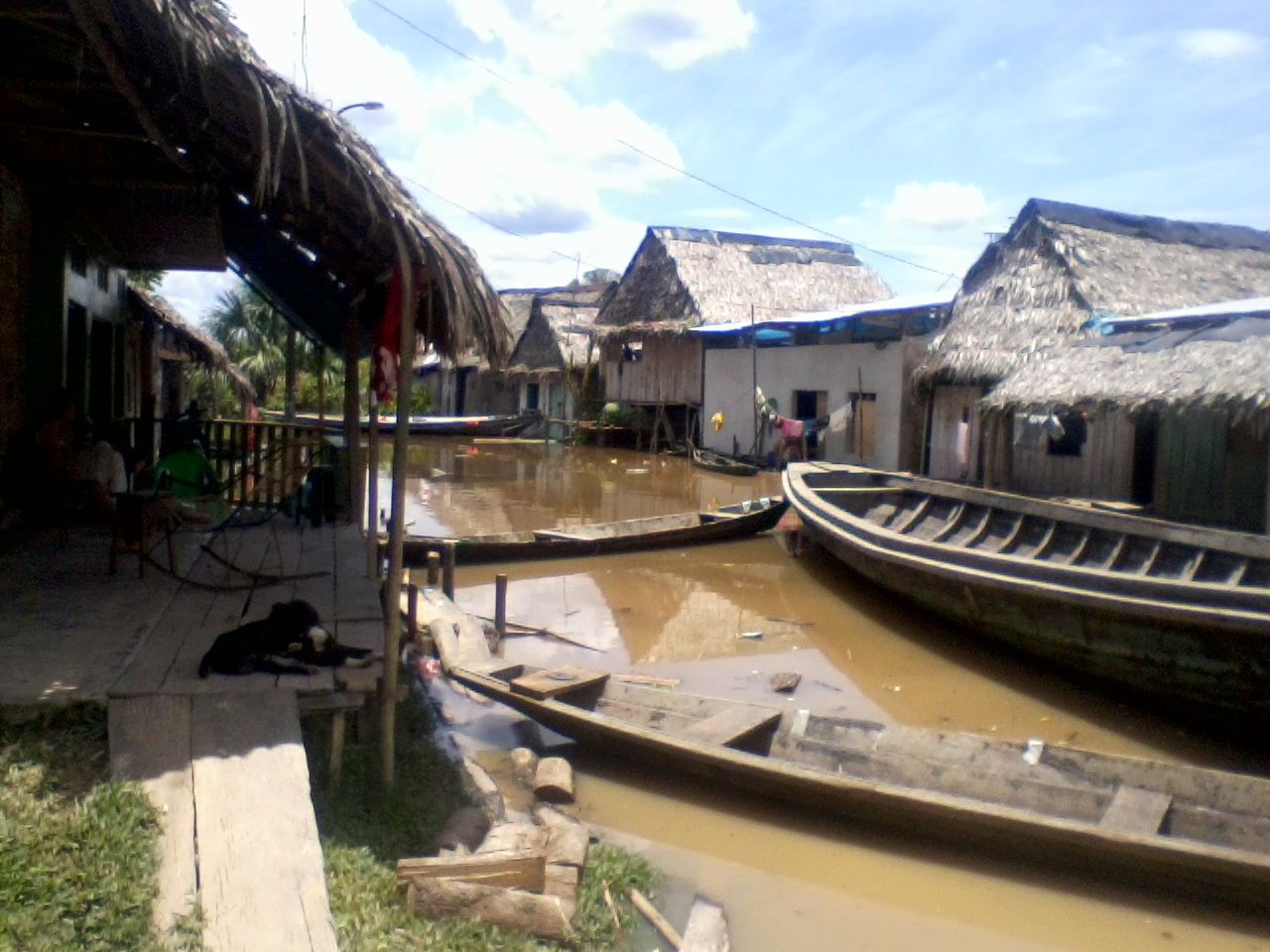
A flooded street in Santa Clara de Nanay, April 2, 2012 (courtesy of Asociación Benéfica Prisma)
Josh Colston of the Division of Infectious Diseases and International Health, University of Virginia School of Medicine, Charlottesville, presented his findings on the connection between floods and enteric pathogens in Peru at the 2019 meeting of the American Society of Tropical Medicine and Hygiene. Below he has shared us with a summary of his work and findings. A link to the recently published work is also provided.
Climate change represents an impending global public health threat since extreme weather events like floods can cause injury and drowning, toxic exposure, and the spread of infectious diseases. Poor people living in unplanned settlements with inadequate infrastructure are most vulnerable to these impacts. Outbreaks of gastroenteritis often occur following floods and can be particularly serious for young children. But there are many different bugs that can cause this illness and it’s not yet known which of them are most prone to contaminating floodwater. However, a newly published paper in the International Journal of Environmental Research and Public Health may shed some light thanks to a small piece of serendipity in an otherwise devastating natural disaster.

Location of the study site
The 2010-2012 La Niña event (the colder counterpart of El Niño) caused huge disruption to weather patterns over several continents. The Amazonian region of Peru around the city of Iquitos was particularly badly hit by heavy rains. It’s a low-lying area particularly prone to flooding since it’s situated at the confluence of several Amazon tributaries. Waterways are the main transport routes in the region, so most of the population lives close to the banks of the rivers. Following months of heavy rainfall in late 2011 and early 2012, three of the rivers – the Ucayali, Marañón, and Nanay – burst their banks, causing widespread flooding and forcing many locals to abandon their homes and evacuate to drier areas. By the end of the disaster, an estimated 50,000 people had been made homeless.
It just so happened that, in a quiet fishing town on the outskirts of Iquitos called Santa Clara de Nanay, an epidemiologic surveillance study was being carried out. Around 300 babies had been recruited and field workers were taking regular measurements and biological samples to see how they were growing and what bugs they were catching. Using a special epidemiologic method known as ‘causal inference’ researchers were able to compare the samples of the infants’ poop before, during and after the flood to see how the rates of infection changed.
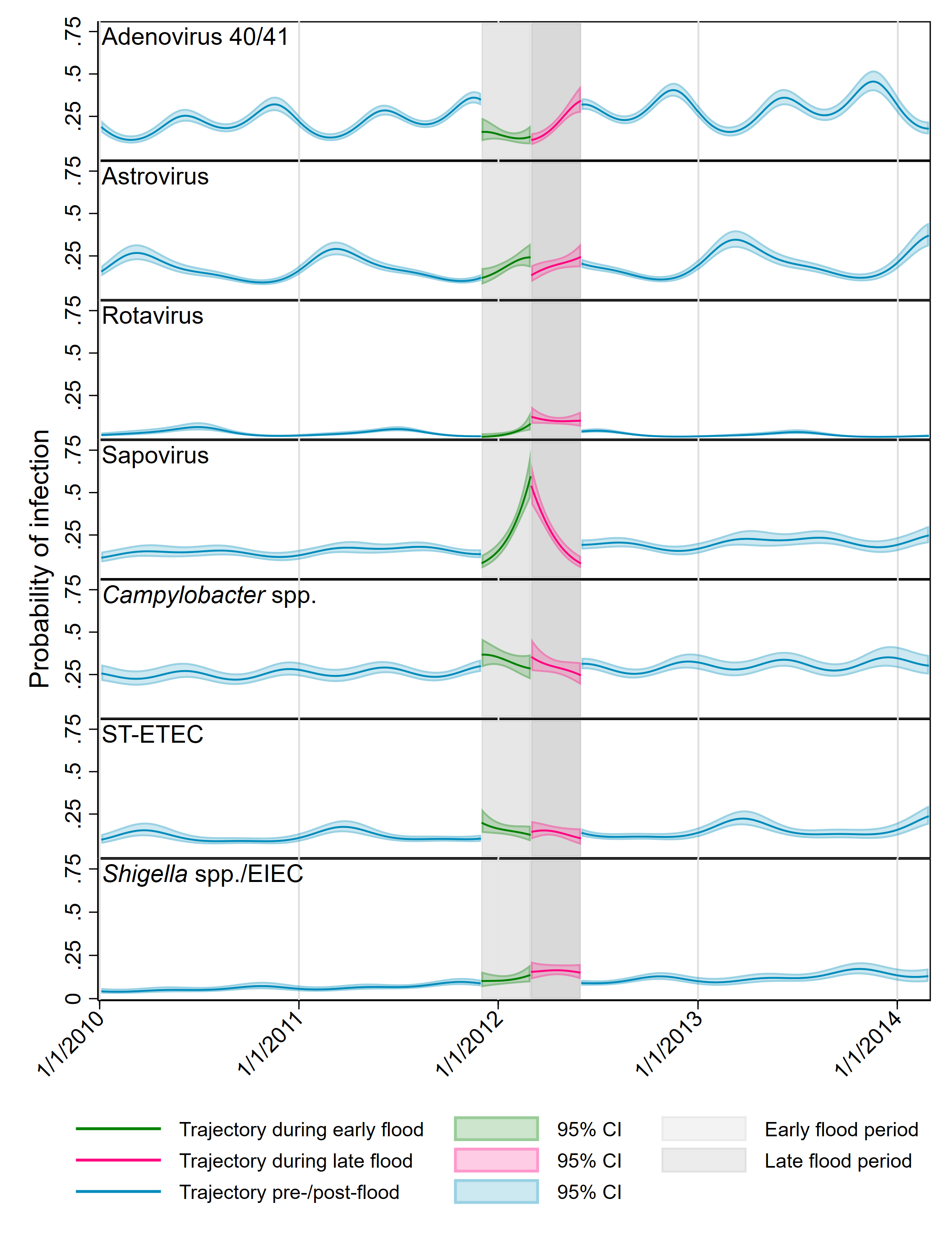
Estimated prevalence rates of four viruses and three bacteria before, during and after the flood
Interestingly, two viruses showed substantial upticks during the flood. Rates of rotavirus were 5 times, and sapovirus 2.5 times the normal level for that time of year. What’s more, the rotavirus cases seemed to be caused by unusual virus strains that were not common in the area and which are less preventable by vaccine. Meanwhile, three bacteria – Campylobacter, Shigella and a type of E. coli called ST-ETEC – showed smaller increases. It’s common to catch Campylobacter from poultry and, since a lot of households in Santa Clara keep chickens in their yards, it’s possible that the mini-outbreak was cause by floodwater washing chicken droppings out of the coops and into the wider environment.
What’s clear from this and other recent studies, is that we need to start thinking bigger when it comes to drainage and sanitation solutions. Traditional low-cost, household-level improvements to water sources and sanitation facilities may not be up to the task in the face of climate events that may suddenly and unexpectedly expose entire communities to large amounts of untreated sewage. Investments in more ambitious, municipal-level water, wastewater, and drainage infrastructure – the kind that historically brought about massive, society-wide child health improvements in high income countries – may be the only sure route to climate resilience.
Borders &CHW &Climate &Elimination &IPTi &Sahel &Surveillance &Vector Control Bill Brieger | 26 Sep 2018
Hopefully Malaria Elimination will not be the SaME
The Sahel Malaria Elimination Initiative (SaME) has been launched, but builds on a long history of cooperation in the region. Efforts by eight Sahelian countries to share lessons and strategies mirrors the Elimination Eight group on the opposite end of the continent.
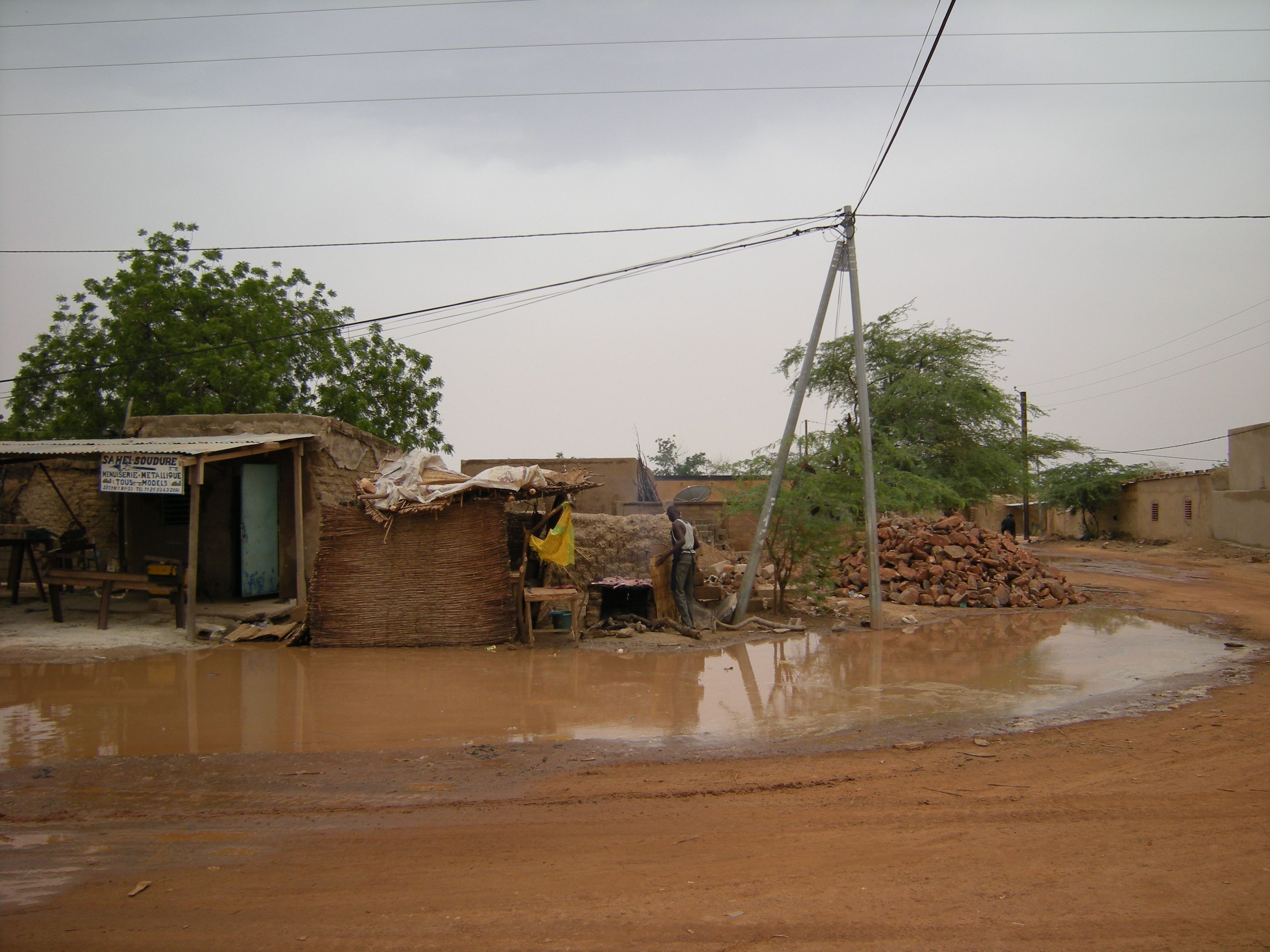
The few rainy season months in the Sahel offer optimum malaria transmission, which SaME is tackling
The Roll Back Malaria (RBM) Partnership to End Malaria announced that in Dakar on 31st August 2018, the health “ministers from Burkina Faso, Cabo Verde, Chad, Mali, Mauritania, Niger, Senegal and The Gambia established a new regional platform to combine efforts on scaling up and sustaining universal coverage of anti-malarials and mobilizing financing for elimination.” The group plans a fast-track introduction of “innovative technologies to combat malaria and develop a sub-regional scorecard that will track progress towards the goal of eliminating malaria by 2030.” This will build on the existing country scorecard that has been developed and implemented by AMLA2030 for all countries in the region and tracks roll out of key malaria and health interventions. The Sahel Malaria Elimination Initiative will be hosted by the West African Health Organization, a specialised agency of the Economic Community of West African States (ECOWAS).
RBM explains that while the eight countries will work together, they do not have a homogenous epidemiological picture or experience with malaria programming. The Sahel experiences 20 million annual malaria cases, according to RBM, and “the Sahel region has seen both achievements and setbacks in the fight against the disease in recent years.” These eight have a highly variable malaria experience. Burkina Faso and Niger continue to be among the countries with high malaria burdens. Cabo Verde is on target for malaria free status by 2020. The Gambia, Mauritania and Senegal are reorienting their national malaria program towards malaria elimination. A benefit of this epidemiological and programmatic diversity is that countries can learn important lessons from each other.
The SaME Initiative will use the following main approaches to accelerate the combined efforts towards the attainment of malaria elimination in the sub-region:3
- Regional coordination
- Advocacy to keep malaria elimination high on the development and political agenda
- Sustainable financing mechanisms
- Cross-border collaboration and ensuring accountability
- Fast-track the introduction of innovative and progressive technologies
- Re-enforcing the Regional regulatory mechanism for quality of malaria commodities and introduction of new tools.
- Establish malaria observatory, regional surveillance, and best practice sharing
Collaboration across borders on vector control is an example of needed regional coordination. According to Thomson et al., climate variations have the potential to significantly impact vector-borne disease dynamics at multiple space and time scales. Another challenge to vector control in the region is the issue of how mosquitoes repopulate areas after an extended dry season. Huestis et al. examined the response of Anopheles coluzzii and Anopheles gambiae to environmental cues in season change in the Sahel.

Seasonal Malaria Chemoprevention Round 3 of 2018 in Burkina Faso
In addition to a history of cooperation, Sahelian countries share a unique malaria intervention, Seasonal Malaria Chemoprevention (SMC) that as the name implies, built on the reality of highly seasonal transmission in the region. SMC grew out of over five years of research in several African settings to test the effect of what was originally termed Intermittent Preventive Treatment for Infants (and later children) or IPTi.
Like IPT for pregnant women, SMC would be given monthly for at least 3-4 months, but unlike IPTp, SMC would consist of a combination two medicines, amodiaquine plus sulfadoxine-pyrimethamine (AQ+SP), which required a three daily doses (SP alone as used in IPTp consists on one dose). SMC could not therefore, be delivered effectively as a clinic-based intervention, but “should be integrated into existing programmes, such as Community Case Management and other Community Health Workers schemes.” Access to SMC by pre-school aged children as delivered by CHWs was found to be more equitable than sleeping under an LLIN. SMC has been recommended for school-age children, a neglected group that bears a substantial burden of malaria.
Closely linked to surveillance is modeling the spatial and temporal variability of climate parameters, which is crucial to tackling malaria in the Sahel. This requires reliable observations of malaria outbreaks over a long time period. To date efforts are mainly linked to climate variables such as rainfall and temperature as well as specific landscape characteristics. Other environmental and socio-economic factors that are not included in this mechanistic malaria model.
The Sahel Malaria Elimination initiative offers a unique collaborative opportunity for countries to improve on the quality of proven interventions like SMC and test and take to scale new strategies like school-based malaria programs. Regional coordination can produce better, timelier and longer-term surveillance and better understanding of and actions against malaria vectors. Readers will surely be anticipating the publishing of the regular progress malaria elimination scorecards as promised by SaME leadership.
Climate &Community &Development &Epidemiology &Malaria in Pregnancy &Mosquitoes &Surveillance &Urban &Zoonoses Bill Brieger | 11 Jul 2017
Population Health: Malaria, Monkeys and Mosquitoes
 On World Population Day (July 11) one often thinks of family planning. A wider view was proposed by resolution 45/216 of December 1990, of the United Nations General Assembly which encouraged observance of “World Population Day to enhance awareness of population issues, including their relations to the environment and development.”
A relationship still exists between family planning and malaria via preventing pregnancies in malaria endemic areas where the disease leads to anemia, death, low birth weight and stillbirth. Other population issues such as migration/mobility, border movement, and conflict/displacement influence exposure of populations to malaria, NTDs and their risks. Environmental concerns such as land/forest degradation, occupational exposure, population expansion (even into areas where populations of monkeys, bats or other sources of zoonotic disease transmission live), and climate warming in areas without prior malaria transmission expose more populati ons to mosquitoes and malaria.
Ultimately the goal of eliminating malaria needs a population based focus. The recent WHO malaria elimination strategic guidance encourages examination of factors in defined population units that influence transmission or control.
Today public health advocates are using the term population health more. The University of Wisconsin Department of Population Health Sciences in its blog explained that “Population health is defined as the health outcomes of a group of individuals, including the distribution of such outcomes within the group.” World Population Day is a good time to consider how the transmission or prevention of malaria, or even neglected tropical diseases, is distributed in our countries, and which groups and communities within that population are most vulnerable.
World Population Day has room to consider many issues related to the health of populations whether it be reproductive health, communicable diseases or chronic diseases as well as the services to address these concerns.
Climate &Environment &Mosquitoes &Zoonoses Bill Brieger | 22 Apr 2017
Earth Day, Climate, Environment and Malaria
 The Earth Day website notes that, “Our planet is currently losing over 15 billion trees each year—that’s 56 acres of forest every minute. We’re working hard to reverse that trend by supporting global reforestation projects. Earth Day Network’s Reforestation Campaign benefits local communities, increases habitat for species, and combats climate change.”
This habitat change if often conducive to the spread of malaria in areas and among populations that may not have been affected before. Specifically, “More risks associated with El Niño are: flooding and landslides in the Americas, drought in Southeast Asia and Australia, scrambled fisheries, and malaria, cholera, and dengue outbreaks.”
Terry Devitt reported that the incidence of malaria jumps when Amazon forests are cut, establishing a firm link between environmental change and human disease. The report, which combines detailed information on the incidence of malaria in 54 Brazilian health districts and high-resolution satellite imagery of the extent of logging in the Amazon forest, shows that clearing tropical forest landscapes boosts the incidence of malaria by nearly 50 percent (according to Olson and colleagues).
Moyes et al. Predicted the geographical distributions of the macaque hosts and mosquito vectors of Plasmodium knowlesi malaria in forested and non-forested areas of Southeast Asia. When urbanization and deforestation bring people into habitats they never lived in, zoonotic transmission of malaria results. Fornace et al. similarly observed that, “Marked spatial heterogeneity in P. knowlesi incidence was observed, and village-level numbers of P. knowlesi cases were positively associated with forest cover and historical forest loss in surrounding areas. These results suggest the likelihood that deforestation and associated environmental changes are key drivers in P. knowlesi transmission in these areas” of Malaysia.
Back to Brazil, de  Alvarenga and co-researchers reported in the transmission of Plasmodium simian malaria in the Brazilian Atlantic forest as a natural infection of capuchin monkeys (Cebinae subfamily). Because of human movement into forest areas, cases among people have now been documented.
The zoonotic transmission of malaria to humans due to changes in climate, environment and habitat pose another unwanted challenge to global efforts to eliminate malaria. On Earth Day it is imperative for malaria control and elimination workers to collaborate closely with colleagues in environmental health and protection.